A boundary surface is defined to be either the mathematical envelope between a charged region and empty space, where the density fields associated with the region vanish, or the mathematical envelope between two electrically different regions in contact, where the density fields associated with the two change abruptly.
en: superficie límite
cylindrical layer
noun
Where k is the thermal conductivity of insulation and h is the external convection heat transfer coefficient.
en: capa cilíndrica
energy balance
noun
the relation between intake of food and output of work (as in muscular or secretory activity) that is positive when the body stores extra food as fats and negative when the body draws on stored fat to provide energy for work.
en: balance de energía
Stefan–Boltzmann
noun
a physical constant symbolized by the Greek letter σ, is the constant of proportionality in the Stefan-Boltzmann law, where "the total (physical) intensity radiated over all wavelengths increases as the temperature increases" of a body black that is proportional to the fourth power of thermodynamic temperature.1 The theory of thermal radiation establishes the theory of quantum mechanics, using physics to relate to the molecular, atomic, and subatomic levels.
en: Stefan – Boltzmann
Thermal conductivity
noun
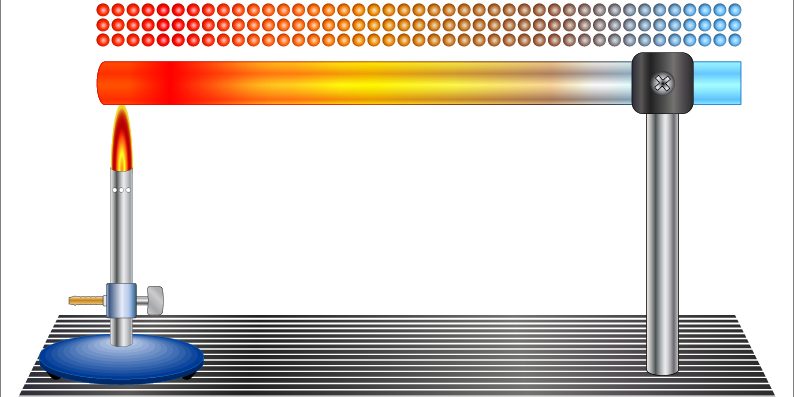
Thermal conductivity (often denoted by k, λ, or κ) refers to the intrinsic ability of a material to transfer or conduct heat. It is one of the three methods of heat transfer, the other two being convection and radiation. Heat transfer processes can be quantified in terms of appropriate rate equations. The rate equation in this heat transfer mode is based on Fourier’s law of heat conduction.